
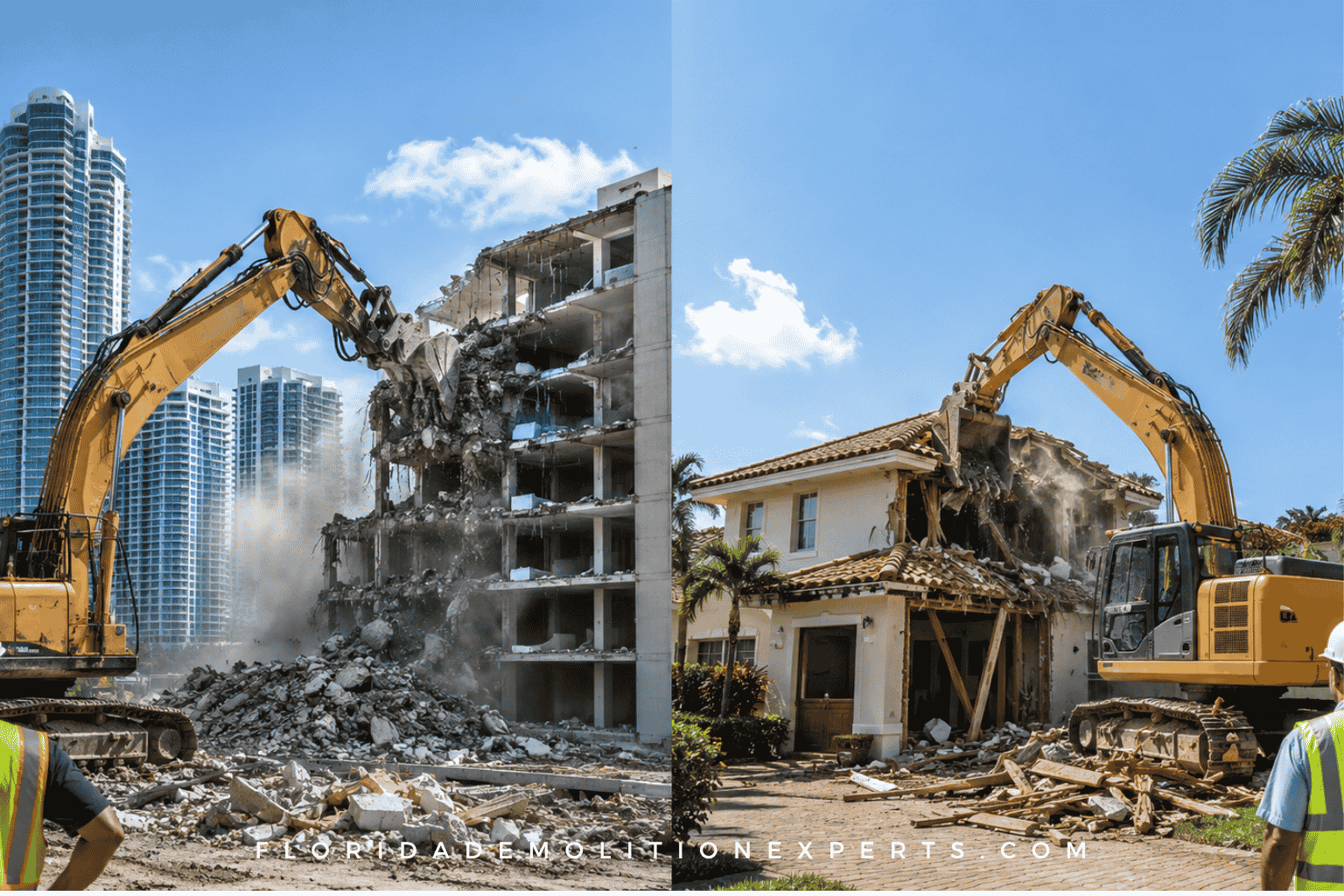
Commercial vs. residential demolition permits in South Florida differ in three core ways: review complexity, required documentation, and cost. Residential demolition permits in Miami-Dade, Broward, and Palm Beach counties follow a relatively standard process with fewer supporting documents.
In contrast, commercial demolition permits require structural engineering review, additional safety plans, and often coordination with multiple regulatory agencies.
A residential demolition permit typically takes 1 to 3 weeks to approve. A commercial demolition permit typically takes 3 to 8 weeks, sometimes longer for large or occupied structures.
What Has to Happen Before You Apply for Either Permit?
Step 1: Identify Your Project Type
A mixed-use building, a multi-tenant commercial space, and a standalone single-family home are reviewed under entirely different permit tracks in every South Florida county.
Step 2: Order The Right Inspections
Both permit types require an asbestos survey, but commercial structures often need additional environmental testing depending on prior use (auto shops, dry cleaners, and medical facilities are subject to extra scrutiny).
Step 3: Hire a Structural Engineer for Commercial Projects
Most South Florida jurisdictions require a licensed engineer to certify the demolition plan for commercial structures. Residential demolitions rarely require this step unless the structure is multi-story or shares a wall with another building.
Step 4: Submit a Safety Plan For Commercial Demolitions
This includes fencing, signage, dust control, and a plan for protecting adjacent tenants or businesses. Residential permits do not require a separate safety plan in most cases.
Step 5: Apply Through The Correct Department
Commercial and residential permits are frequently reviewed by different teams within the same building department, even in the same city.
Get the Right Permit Filed the First Time
Florida Demolition Experts handles both commercial and residential demolition permits across Miami-Dade, Broward, and Palm Beach counties every week.
We know exactly which documents your specific project needs, which engineer sign-offs are required, and which building department reviews your application, so nothing gets bounced back for missing paperwork.
Call us or submit a project inquiry, and we will tell you exactly what your permit requires before you spend a dollar on the wrong paperwork.
Why Do Commercial and Residential Demolition Permits Get Reviewed Differently?
The difference comes down to risk and occupancy. A single-family home being demolished affects one property, and typically, no neighbors actively use the building.
A commercial structure may be attached to active businesses, may have multiple tenants, may carry a more complex structural history, and may involve hazardous materials tied to its commercial use.
Building departments in Miami-Dade, Broward, and Palm Beach counties scale their review requirements to match that risk.
For background on residential demolition permitting specifically, see ” Residential Demolition Permit in Florida.”
For a deeper look at commercial permits on their own, see: Commercial Demolition Permits in Florida.
How Does Engineering Review Differ Between the Two Permit Types?
Residential Demolition Engineering Requirements
Most single-family residential demolitions in South Florida do not require a licensed structural engineer’s review. The exceptions are multi-story homes, structures that share a party wall, or homes in flood zones that require specific documentation for foundation removal.
Commercial Demolition Engineering Requirements
Commercial demolition permits in nearly every South Florida jurisdiction require a Florida-licensed structural engineer to review and certify the demolition sequence.
According to the Florida Board of Professional Engineers, structural demolition plans for commercial buildings must be signed and sealed by a licensed engineer before a building department will accept the permit application in most counties.
This requirement exists because commercial structures are more likely to have load-bearing systems that affect adjacent buildings, shared infrastructure, or structural elements that are not visually obvious from the exterior.
What Documentation Does Each Permit Type Require?
Residential Permit Documents
- Completed permit application
- Proof of property ownership
- Site survey
- Asbestos inspection report (for pre-1980 construction)
- Contractor license and insurance certificate
- Notice of Commencement
Commercial Permit Documents
- Completed permit application
- Proof of property ownership
- Site survey and structural plans
- Asbestos and environmental inspection reports
- Structural engineer’s certified demolition sequence
- Contractor license and insurance certificate
- Safety and traffic control plan
- Notice of Commencement
- Adjacent property notification (where applicable)
- Utility disconnect confirmations from all affected providers
For Broward-specific permit timelines on either track, see: How Long Does the Demolition Permit Take in Broward County?
Does the Permit Process Differ by County in South Florida?
Miami-Dade County
Commercial demolition permits in Miami-Dade are subject to additional review by the Miami-Dade Department of Regulatory and Economic Resources for larger structures, particularly those involving asbestos abatement or historic designation review.
Broward County
Broward County’s Permitting, Licensing, and Consumer Protection Division separates commercial and residential reviews into distinct permitting tracks, even within the same building department. Commercial applications routed to the wrong track are a common cause of delay.
Palm Beach County
Palm Beach County Building Division requires commercial demolition applicants to submit a traffic and safety control plan for any project affecting a public right-of-way, a requirement that residential applicants rarely face.
For a side-by-side look at how individual Broward cities handle commercial permitting differently, see: Commercial Demolition Permits in Fort Lauderdale vs. Pompano Beach vs. Deerfield Beach.
How Much More Does a Commercial Demolition Permit Cost?
Commercial demolition permit fees in South Florida typically range from $500 to $5,000 or more, compared to $150 to $800 for a standard residential permit. The gap reflects the added engineering review, additional inspections, and the broader scope of most commercial structures.
Beyond the permit fee itself, commercial projects often carry additional costs that residential projects do not:
- Structural engineering review fees
- Additional environmental testing for prior commercial use
- Safety plan development and implementation
- Adjacent property protection measures
For a broader operational comparison beyond permits, including cost and equipment differences, see: Residential vs. Commercial Demolition.
Frequently Asked Questions
Can a residential demolition contractor pull a commercial demolition permit?
Only if the contractor holds the appropriate license classification for commercial work, Florida contractor licensing distinguishes between residential and commercial scopes, and many residential demolition contractors are not licensed to perform or permit commercial demolition projects.
Does a mixed-use building need a commercial or residential demolition permit?
Mixed-use buildings are almost always permitted under the commercial track, even if part of the structure includes residential units. The presence of any commercial space typically triggers the full commercial review process.
Why does my commercial demolition permit need an engineer when my neighbor’s residential teardown didn’t?
Commercial structures are more likely to have load-bearing systems, shared walls, or structural elements that affect surrounding properties. Building departments require engineering certification for commercial projects to confirm that the demolition sequence will not compromise nearby structures.
Is asbestos testing required for both residential and commercial demolition permits?
Yes, both permit types require an asbestos survey for structures meeting age or condition thresholds under EPA NESHAP regulations. Commercial structures frequently require more extensive testing depending on the building’s prior use.
Can I speed up a commercial demolition permit by hiring an expediter?
Permit expediters can help ensure your application package is complete before submission, reducing the most common cause of delay: incomplete documentation. They cannot bypass required engineering review or mandatory waiting periods.
Florida Demolition Experts Handles Both Permit Tracks
Whether your project is a single-family residential teardown or a multi-tenant commercial demolition, Florida Demolition Experts manages the entire permitting process across Miami-Dade, Broward, and Palm Beach counties.
We know which documents your specific project needs, coordinate engineering reviews for commercial projects, and ensure your application lands on the correct review track the first time.
Stop guessing which permit track your project belongs to. Contact us and get a clear answer on exactly what your permit requires before you file anything.