
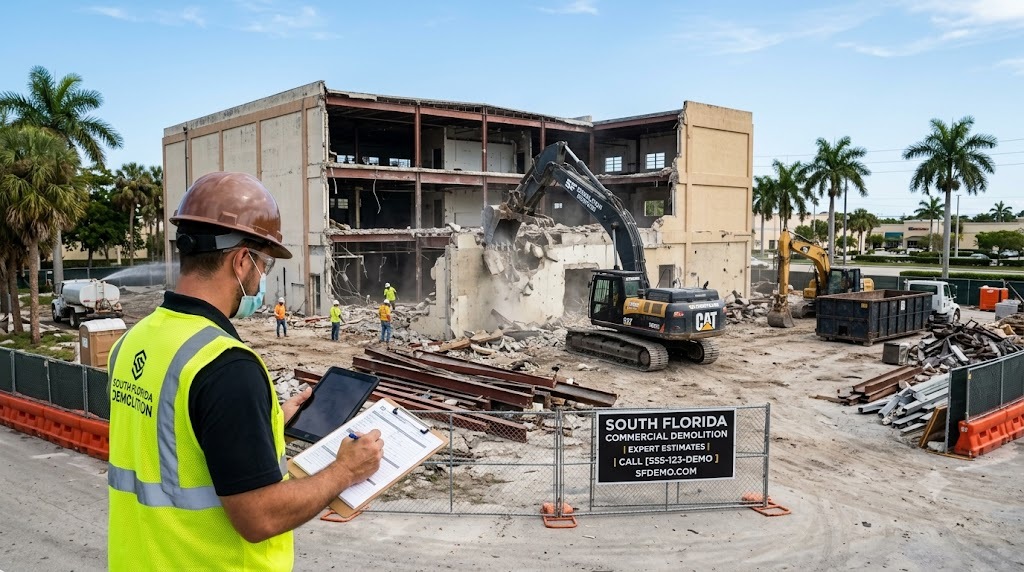
What’s included in a commercial demolition estimate? A complete commercial demolition estimate in South Florida should itemize labor, equipment, permit and inspection fees, debris hauling and disposal, asbestos and environmental testing, utility disconnection coordination, site safety measures, and final site cleanup or grading.
Estimates that bundle everything into a single lump-sum number without breaking out these categories make it difficult to know what you are actually paying for and where costs could change once work begins.
What’s Commonly Left Out of a Lowball Estimate
- Asbestos abatement, if materials are found after the initial survey
- Engineering review fees on structures requiring a certified demolition sequence
- Utility disconnect confirmation delays that extend the timeline and crew costs
- Site grading and final cleanup, sometimes treated as a separate add-on
- Permit re-submission fees if the original application is incomplete
What a Complete Commercial Demolition Estimate Should Include
| Line Item | What It Covers |
|---|---|
| Labor and crew | Demolition crew hours, supervision, specialized operators |
| Equipment | Excavators, breakers, hauling trucks, rental or owned equipment costs |
| Permit and inspection fees | Application costs, engineering review fees, required inspections |
| Asbestos and environmental testing | Survey costs, lab analysis, abatement if materials are found |
| Debris hauling and disposal | Dumpster or truck hauling, landfill or recycling facility fees |
| Utility disconnection coordination | Coordinating disconnects with electric, gas, water providers |
| Site safety measures | Fencing, signage, dust and noise control, traffic control if applicable |
| Final site cleanup or grading | Debris-free lot, grading to prevent erosion, ready for next phase |
Why Does a Commercial Demolition Estimate Need to Be Itemized?
A single lump-sum number tells you what the project costs but nothing about why. An itemized estimate, similar in spirit to the breakdown we use in our commercial demolition cost guide for Florida, lets you see exactly where your money goes: labor, equipment, permitting, environmental testing, and disposal.
This matters most when comparing bids from multiple contractors, since two estimates with the same bottom-line number can represent very different scopes of work.
It also matters once the project is underway. If a change order comes up, an itemized estimate makes it clear whether the new cost is reasonable or inflated, because you already know what was priced into the original number.
What Does Labor and Equipment Actually Cover in a Commercial Estimate?
Labor costs in a commercial demolition estimate typically reflect crew size, project duration, and any specialized operators required for mechanical or selective demolition.
Equipment costs reflect what machinery the project requires: excavators, hydraulic breakers, and hauling trucks, whether owned by the contractor or rented for the specific job.
Larger commercial structures, multi-story buildings, or projects that require selective demolition around an active business typically incur higher labor costs because the work demands more careful sequencing and supervision.
What Permit and Inspection Costs Belong in a Commercial Demolition Estimate?
A legitimate commercial demolition estimate should include the permit application fee and any structural engineering review costs required by most South Florida jurisdictions.
According to research published by the National Association of Home Builders, permit-related costs and review timelines are consistently among the most underestimated line items in construction and demolition project budgeting nationally, which is exactly why a transparent estimate should separate permit costs from labor and equipment rather than folding them into a single number.
If you want a deeper look at what the permit process itself requires in Florida, our guide on commercial demolition permits breaks down the documentation and review steps involved.
Why Does Environmental Testing Show Up as Its Own Line Item?
Asbestos and environmental testing costs are typically itemized separately because the survey results directly affect the rest of the project. A clean survey adds a modest, predictable cost. A positive finding requires abatement, which can add thousands of dollars and weeks to the timeline.
A transparent estimate separates the survey cost from any contingency for abatement, so you understand both the base cost and the potential additional cost if materials are found.
What Happens to Debris and Disposal Costs in the Estimate?
Debris hauling and disposal costs depend on the volume and type of material being removed and on whether the material is landfilled or routed to a recycling facility.
This line item should specify whether the cost is a flat estimate based on projected volume or a per-load charge that could vary once the actual demolition volume is known.
What Red Flags Suggest an Estimate Is Incomplete?
- A single lump-sum number with no breakdown by category
- No mention of permit fees, engineering review, or inspection costs
- No reference to asbestos or environmental testing
- Verbal-only estimates with nothing in writing
- A price significantly lower than competing bids, with no explanation for the gap
If a contractor cannot explain what is and is not included in their number, treat that as a signal to ask more questions before signing, not a reason to assume the lower number is the better deal.
How Do You Compare Multiple Commercial Demolition Estimates?
Accurately comparing estimates requires looking at scope, not just the final number. Confirm whether each estimate includes the same line items: permit fees, environmental testing, disposal, and site cleanup.
A guide like our breakdown on getting accurate demolition quotes walks through the specific questions to ask each contractor so you are comparing equivalent scopes of work rather than two unrelated numbers.
Once you have a written estimate you intend to move forward with, confirm what becomes part of the binding contract. Our guide to what’s included in a demolition contract explains the difference between the estimate stage and the legally binding agreement that follows.
Does Insurance Affect What’s in a Commercial Demolition Estimate?
A contractor’s general liability insurance typically does not appear as a separate line item on the estimate, but it should be confirmed before signing regardless.
Our breakdown of commercial demolition insurance requirements explains what coverage a contractor should carry and why requesting a certificate of insurance is a standard, reasonable request at the estimate stage, not just after you sign a contract.
Frequently Asked Questions
Should a commercial demolition estimate be free?
Most licensed commercial demolition contractors in South Florida provide an initial estimate at no cost, particularly for straightforward projects. More complex commercial structures may require a site visit and a more detailed scoping process before a precise number can be provided.
How accurate is a commercial demolition estimate compared to the final cost?
A well-prepared estimate should be close to the final cost, with variance typically tied to unforeseen conditions such as asbestos findings or structural surprises discovered once work begins. This is why a transparent estimate separates predictable costs from contingencies that depend on what is found during the project.
Why do two commercial demolition estimates for the same building come back so differently?
Estimates can vary because contractors are pricing different scopes of work, different equipment approaches, or different assumptions about permit and environmental costs. Comparing line items, not just the bottom-line number, usually explains the gap.
Does a commercial demolition estimate include the cost of asbestos abatement?
Typically, the estimate includes the cost of the asbestos survey itself, but abatement costs are usually presented as a contingency or as a separate line item, since they apply only if the survey finds regulated materials.
What should I ask a contractor if their estimate seems incomplete?
Ask directly which categories are included: labor, equipment, permits, environmental testing, disposal, and site cleanup. A reputable contractor will walk through each one without hesitation. Vague or evasive answers are a signal to get a second estimate.
Is a verbal estimate enough to move forward with a commercial demolition project?
No. A written, itemized estimate protects both parties and gives you something concrete to compare against other bids. Verbal-only estimates make it difficult to hold a contractor accountable if the final invoice differs significantly from the discussion.
Can the estimate change after the contract is signed?
Yes, in specific circumstances, typically tied to unforeseen conditions like asbestos discovery or structural issues not visible during the initial assessment. A transparent contractor explains upfront what could trigger a change order and how that process works before you sign.
Florida Demolition Experts Provides Estimates You Can Actually Compare
Every commercial demolition estimate we provide across Miami-Dade, Broward, and Palm Beach counties is itemized by labor, equipment, permitting, environmental testing, disposal, and site cleanup, so you know exactly what you are paying for before you sign anything.
Contact us or submit a project inquiry and get a real, written, itemized estimate for your commercial project.