
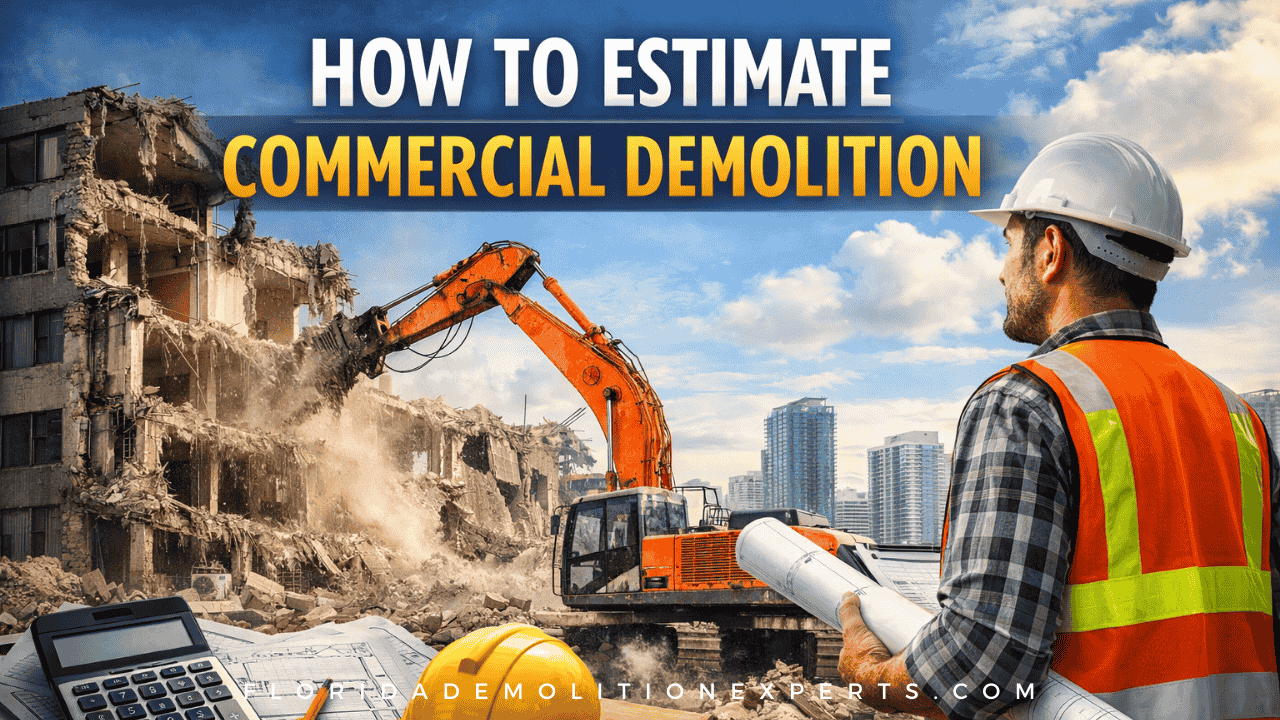
Start with the total gross square footage and apply $8-$15 per square foot for South Florida commercial demolition in 2026. Then adjust for structure type, asbestos abatement, Broward County permits, post-tension slab assessment, utility disconnections, debris disposal, and site access. A flat per-square-foot number is a planning tool only, not a final budget.
What is the first step in estimating a commercial demolition project in Fort Lauderdale?
Define the scope before you touch any numbers. Full structural demolition, selective interior gut-out, and partial exterior removal each carry different costs, timelines, and permit requirements in Broward County.
Full structural demolition removes everything to grade, including the foundation. Interior commercial gut-out strips the building shell while leaving the structure intact.
Partial demolition removes a specific section while occupied or active areas remain in place. Each scope requires a separate permit application and carries different FDOT and Broward County access requirements.
Our guide to commercial demolition costs in Florida breaks down costs by scope and project size for properties in Broward County.
What per-square-foot rate should I use for a commercial demolition estimate in South Florida?
Use $8 to $15 per square foot as your planning range for standard commercial demolition in Broward County in 2026. CBS block and post-tension concrete structures sit at the higher end. Wood-frame and steel-frame buildings with open site access sit at the lower end.
When does the per-square-foot rate exceed $15 in Fort Lauderdale?
Urban commercial projects on Federal Highway, US-1, or downtown Fort Lauderdale corridors regularly exceed $15 per square foot when FDOT lane closures are in effect, equipment access is tight, and adjacent buildings are occupied.
High-rise or multi-story structures also exceed standard rates due to equipment requirements and debris management on active city blocks.
Interior commercial gut-out versus full structural removal
Interior selective demolition costs $3 to $7 per square foot in commercial spaces in Broward County, significantly below the cost of full structural removal.
This scope is common for retail tenant improvements, restaurant conversions, and office reconfigurations across Fort Lauderdale. If the shell and foundation are staying, your estimate should reflect only the interior scope.
What are the major cost drivers that change a commercial demolition estimate in Broward County?
Structure type and hazardous materials account for the largest cost variance in South Florida commercial estimates. Two buildings with identical square footage can differ by $200,000 in total cost based solely on construction type, asbestos presence, and site conditions.
Post-tension slab assessment
Post-tension concrete slabs are common in South Florida commercial construction built after 1980. A licensed structural engineer must assess the slab and map the cable grid before any cutting begins.
This assessment costs $1,500 to $4,000 and cannot be skipped. It is one of the most frequently omitted line items on low commercial demolition bids in Broward County.
Asbestos abatement under NESHAP 40 CFR Part 61
Any commercial structure above threshold size requires an EPA-certified asbestos inspection before a Broward County demolition permit is issued under NESHAP 40 CFR Part 61.
Commercial asbestos abatement in South Florida costs $5,000 to $40,000 depending on material type and quantity. This cost must appear as a separate line item, not buried inside a general demolition number.
FDOT lane closure permits for urban commercial sites
Commercial demolition on or adjacent to a state road in Fort Lauderdale requires an FDOT lane closure permit coordinated at least 10 business days before work begins.
These permits cost $2,000 to $5,000 and add mobilization complexity that affects both cost and schedule on urban Broward County projects.
According to the National Demolition Association, hazardous material abatement and regulatory compliance account for 20 to 35 percent of the total costs of commercial demolition projects for structures built before 1985.
What permits and compliance costs belong in a Broward County commercial demolition estimate?
Broward County Building Division charges $1,500 to $8,000 for commercial demolition permits under Florida Building Code Section 105.1, depending on assessed value and project scope.
An environmental review from Broward County Environmental Protection and Growth Management adds 2 to 4 weeks and additional fees for waterfront or flood zone properties.
Failed inspections carry a $500 re-inspection fee per violation. After-the-fact permits for unpermitted work cost significantly more than standard applications and create financing and title complications for developers on active construction loan timelines.
For a full breakdown of the Broward County permit process, see our residential demolition permit guide, which covers the same Building Division steps that apply to commercial applications.
How do utility disconnections affect a commercial demolition estimate in South Florida?
FPL, Florida City Gas, TECO Peoples Gas, and Broward County Water and Wastewater Services each require an independent disconnection request with a separate lead time. Coordinating all disconnections for a commercial property takes three to five weeks and adds $1,500 to $4,000 in coordination and inspection costs to the estimate.
Delays in utility disconnections are the single most common cause of commercial demolition start-date slippage in Broward County. Budget both the cost and the timeline impact into your project pro forma before committing to a construction loan draw schedule.
Read our full guide on what to do with utilities before demolishing a house for individual provider timelines that apply directly to commercial disconnection planning in Broward County.
What line items should every commercial demolition estimate in Broward County include?
A complete commercial demolition estimate for a Broward County project should include every item below as a separate line. Any bid that combines these into a single number is hiding costs that will surface later as a change order.
- Site assessment and structural engineering
- Asbestos inspection and abatement
- Broward County demolition permit fee
- FDOT lane closure permit if applicable
- Utility disconnection coordination
- Equipment mobilization and labor
- Post-tension slab assessment if applicable
- Debris hauling and C&D disposal under FAC 62-701
- Site grading and cleanup
- Contingency: 15 to 20 percent of total for South Florida commercial projects
For a full breakdown of the factors that drive cost variance, see our article on what factors increase demolition costs in Florida.
How can I accurately compare commercial demolition bids in Fort Lauderdale?
Never compare total numbers across bids. Compare line items. A bid at $180,000 that includes asbestos abatement, post-tension assessment, FDOT permitting, and disposal is a better value than a $140,000 bid that excludes all four.
Request an itemized list of scope exclusions from each contractor before making a decision. Licensed demolition contractors in Broward County will provide this without hesitation.
Any contractor who cannot produce a line-item breakdown with clear inclusions and exclusions is not the right partner for a commercial project on an active development timeline.
Our article on what causes commercial demolition delays in Broward County covers the most common bid and scope gaps that push commercial projects past their scheduled start dates.
Need a Line-Item Commercial Demolition Estimate for Your Broward County Project?
Developers and property owners in Fort Lauderdale know the difference between a ballpark number and a bid they can actually build a pro forma around.
Florida Demolition Experts provides fully itemized commercial demolition estimates covering permits, asbestos inspection, post-tension assessment, utility coordination, disposal, and contingency for every project in Broward County.
No surprises. No change orders buried in a low opening bid. Just an accurate number you can take to your lender.